
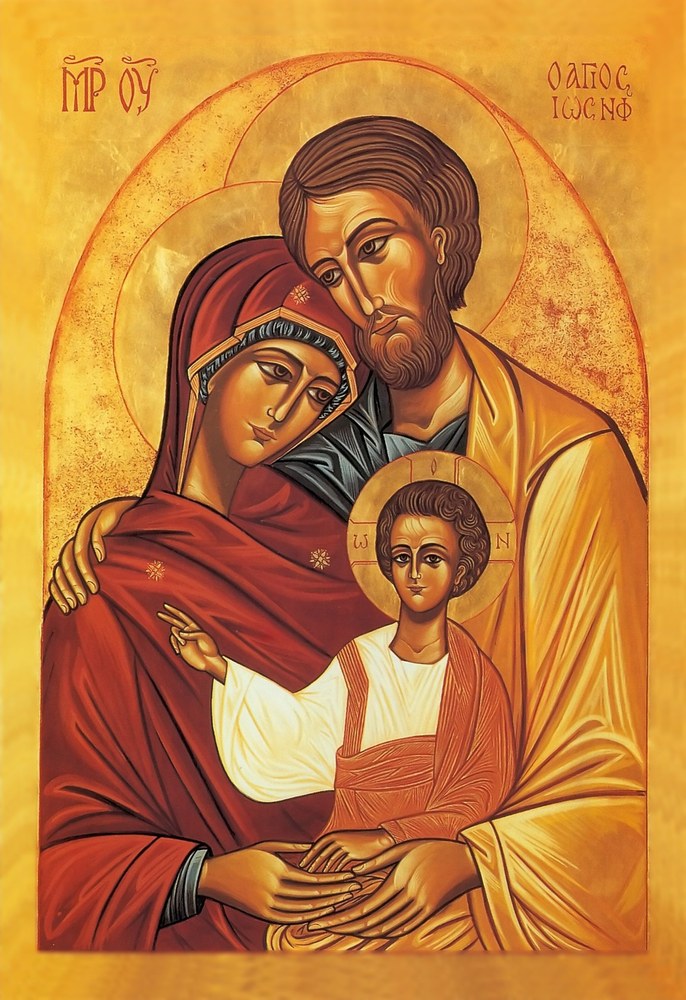
The Icon of the Holy Family: Its Origin and Meaning
Its origin and meaning — an image written for the Teams of Our Lady.
Monastery of the Mount of Olives, Jerusalem
How the Icon Came to Be
Many members of the Teams of Our Lady have this icon of the Holy Family in their homes, yet few know that it is not an ancient image that was simply adopted by our Movement. On the contrary, it was created specifically for us, for Teams of Our Lady.
In 1984, Sister Marie-Paul Farran created this work in response to repeated requests from the Teams of Our Lady, in the iconography workshop of the Benedictine Sisters’ Monastery of the Mount of Olives in Jerusalem. This icon is listed as number 8 in their catalogue and measures 70 cm in height. It was the first icon of the Holy Family produced by the Monastery.
This icon, known as the Icon of the Holy Family, is part of the Movement’s artistic and religious heritage. It was conceived and created specifically for Teams of Our Lady and exclusively by Sister Marie-Paul Farran. Furthermore, our icon is part of the world’s religious heritage.
The monastery describes it this way:
After many requests and many attempts, this icon of the Holy Family was created in our workshop. Since then, this icon has been reproduced many times and has been a source of healing, conversion and reconciliation for many people.
— The Monastery of the Mount of Olives
From that single commission, the image has since spread to homes, chapels and gathering places around the world. But it began with us.
The Iconographer: Sister Marie-Paul Farran
Sister Marie-Paul Farran (1930–2019) wrote the icon. She entered the Benedictine Monastery of Notre-Dame du Calvaire on the Mount of Olives in Jerusalem in 1955, a community founded in 1896 by seven French sisters and soon joined by Palestinian, Egyptian and Lebanese sisters.
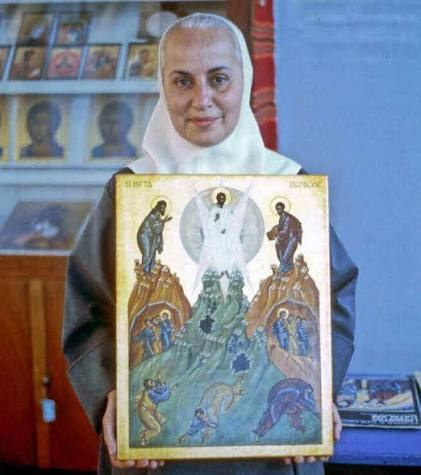
Photo: Monastery of the Mount of Olives
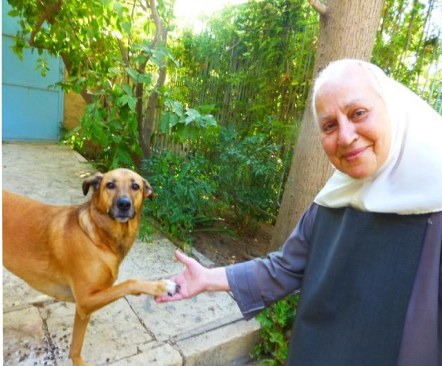
Photo: Monastery of the Mount of Olives
Her work became known internationally for the way it developed an original style out of the Byzantine tradition, and this icon of the Holy Family, written for Équipes Notre-Dame, is her best-known piece. The workshop has been active since the 1960s and is now led by Sister Marie-Bénédicte Martin, who worked alongside Sister Marie-Paul for many years before succeeding her.
What the Icon Represents
Sister Marie-Paul described the icon as an expression of “the mystery of the marriage: total communion, in tenderness.” She grounded that idea in Scripture: the angel’s words to Joseph, “do not be afraid to take Mary home as your wife” (Matthew 1:20), and Isaiah’s image of God as bridegroom, “your husband is your Creator” (Isaiah 54:5).
For her, the marriage of Joseph and Mary points toward something larger: the covenant God wants with every soul, marked by the tenderness he reveals of himself at Sinai as “God of tenderness and compassion” (Exodus 34:6). She called this tenderness “the gratuity of love.”
For a movement whose whole spirituality rests on marriage as a path to holiness, that’s not a small point. This icon is a picture of the very thing the Teams exist to help couples live.
Praying Before the Icon
Sister Marie-Paul also left instructions for how to pray with the icon, rather than simply look at it:
Look at it in silence to become aware that everything it represents is within us. In us, we have the masculine priestly, the feminine royal and the prophetic child… When God, in his tenderness, unifies our being, the Son of God appears in us and we can thus radiate him.
— Sister Marie-Paul Farran
The threefold image of priestly, royal and prophetic comes from Peter’s letter: “a chosen race, a royal priesthood, a consecrated nation, a people set apart” (1 Peter 2:9; cf. Revelation 1:6, Exodus 19:5–6).
On the Nature of an Icon
Sister Marie-Paul wrote more generally about what an icon is, and why the Church has always treated these images as something more than art:
An icon is an image which re-presents an invisible Presence, or, as the Fathers say, “the visible of the Invisible.” Now, the first to make an icon is God himself… Facing an icon, one does not speak, one looks, and the whole Word flows into us through the gaze.
— Sister Marie-Paul Farran
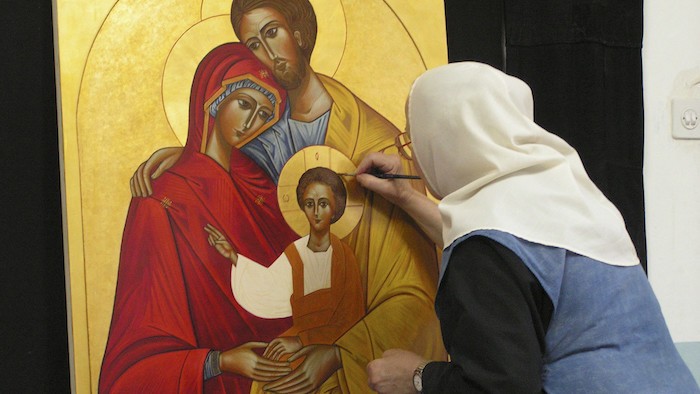
Photo: Monastery of the Mount of Olives
She described the process of writing an icon as its own kind of spiritual ascent: the wood prepared like an altar, the image built up in layers from darkness toward gold and finally to the white light of the glorified face, mirroring the soul’s own climb toward Christ, “the perfect Icon.”
Image credits. The photographs of Sister Marie-Paul Farran and of the icon in progress are reproduced here with gratitude to the Monastery of the Mount of Olives, Jerusalem. For any attribution question, please contact us.
Source: Catalogue Raisonné des icônes de Sœur Marie-Paul Farran et de l’atelier d’iconographie du Monastère des Bénédictines du Mont des Oliviers.

